ServicesPool Repair
Pool Repair in Coolidge
When the pump hums but won't move water, or the pad is dripping, we find the cause and fix it. We explain the part options in plain words, what each one costs you over time, and let you pick before we start.
Fixing What Stopped Working
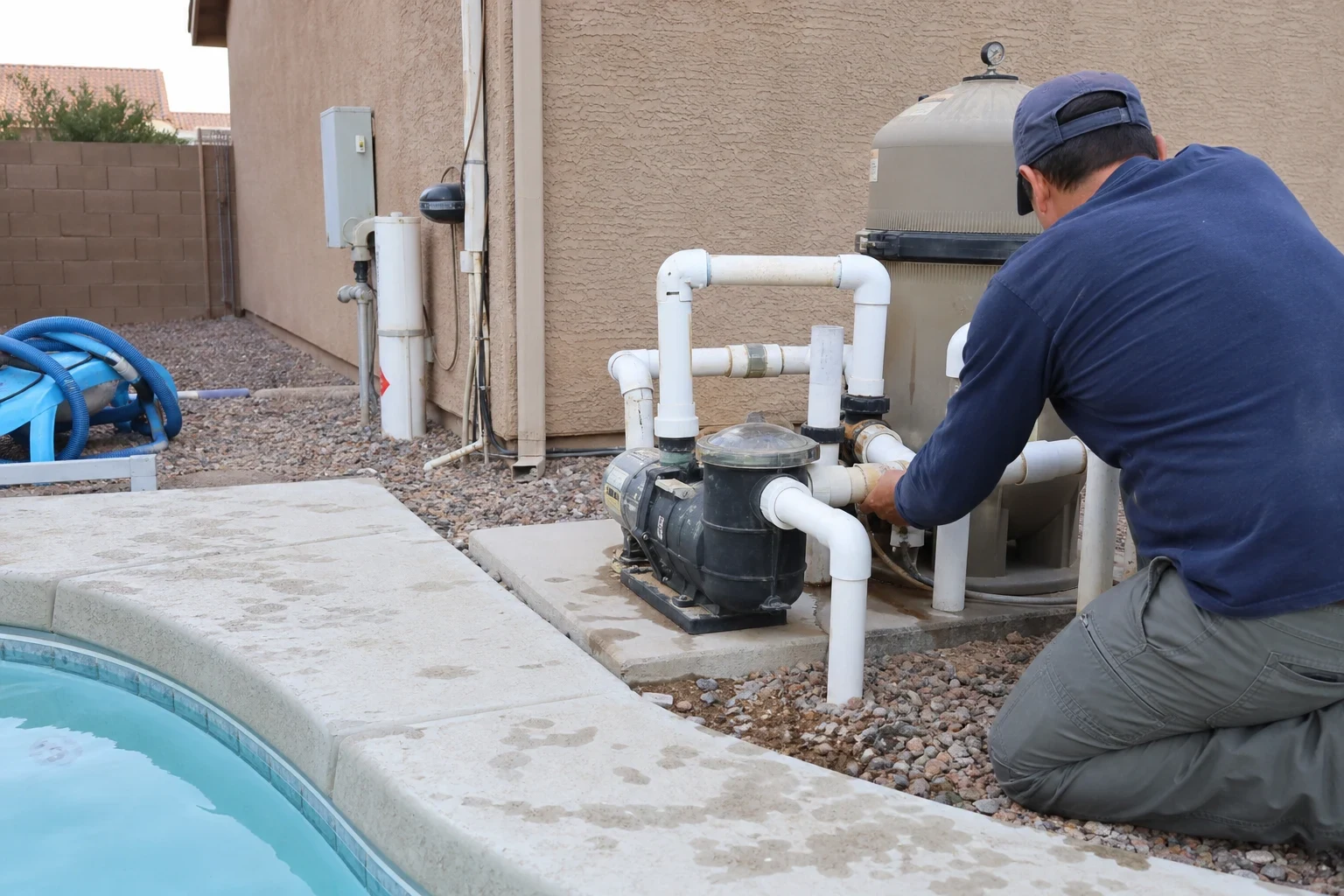
Most pool repair happens at the equipment pad. Pumps, motors, filters, valves, heaters and the pipe that ties them together all sit outside in full sun, year after year. Parts wear out. Seals dry up. Plastic gets brittle. We come out, look at the whole pad, and fix the piece that failed.
A lot of repairs come with a choice of material. A valve can be standard PVC or a heavier-duty body. A pump lid o-ring can be plain rubber or a longer-lasting compound. We tell you what each choice means for how long it lasts and what it costs, then you decide.
If something is worn past saving, we say so. Some jobs are better handled as an equipment installation, and we'll tell you when that's the case instead of patching a part that will fail again next summer.
What Our Pool Repair Covers
- 01
Pump and motor repair
We replace shaft seals, bearings, capacitors, impellers and lid o-rings. A pump that screeches or trips the breaker often needs one of these, not a whole new unit.
- 02
Pad plumbing
Exposed PVC that has cracked from sun and heat gets cut out and replaced. We use pipe and fittings rated for pressure, and we prime and glue every joint the right way so it doesn't weep in a month.
- 03
Valves and unions
Diverter valves that stick or leak get rebuilt or swapped. Rebuilding with a new gasket is cheaper. A new valve body costs more but makes sense when the old housing is chalky and cracked.
- 04
Filter housings and parts
We replace cracked tank lids, worn clamp bands, broken air relief valves and pressure gauges. Routine media care is handled under filter cleaning.
- 05
Heaters and timers
We troubleshoot heaters that won't fire and timers or controls that stopped switching. We'll tell you plainly if a repair is worth it on an older unit.
- 06
Skimmers and fittings
Cracked skimmer lids, broken weir doors and worn return fittings get replaced so the pool skims and circulates the way it should.
Questions about Pool Repair?
Call(520) 462-9055Signs Your Pool Needs a Repair
Water under the pump
A drip at the back of the pump usually means the shaft seal is going. Left alone, the water can reach the motor bearings and turn a small fix into a big one.
Loud grinding or screeching
That sound is usually motor bearings. They wear faster when a motor runs hot all summer.
Air in the pump basket
Bubbles in the lid or spurting returns point to an air leak on the suction side. A dried-out lid o-ring or a cracked fitting is the usual cause.
Filter pressure way off
If the gauge reads high after a cleaning, or the needle won't move at all, something in the system needs a look.
Chalky, cracked plastic
Faded, flaky PVC or valve bodies on the pad have been cooked by UV. They tend to crack without warning, so it pays to replace them on your schedule.
How a Repair Visit Goes
- 1
You call, we talk it through
Tell us what you're seeing and hearing. We'll ask a few questions, give you a free quote by phone where we can, and set a time to come out.
- 2
We check the whole pad
We look at the failed part and what's around it. A bad seal is sometimes caused by a pump running dry, so we look for the reason, not just the symptom.
- 3
You pick the part
We lay out the options and the material trade-offs in plain terms. Nothing gets replaced until you say yes.
- 4
We fix it and test it
We make the repair, prime the pump, run the system and watch for drips or air. Old parts and packaging go with us, and the pad gets left clean.
What Moves the Price of a Repair
Every repair is priced on the part and the labor it takes. We give you the number before we start, and if we find something else once things are apart, we stop and tell you first.
- The part and its material
- A rubber o-ring and a heavy-duty valve body are very different costs. Better materials cost more up front and usually last longer in the heat.
- Equipment brand and age
- Common pumps and filters have parts on hand. Older or discontinued models can take longer to source, or may not be worth repairing.
- How much is damaged
- A seal caught early is a quick job. A seal that leaked into the motor bearings means more parts and more time.
- Access at the pad
- Tight pads, buried unions or pipe run in awkward spots take longer to work on safely.
Pool Repair Questions
Should I repair my pump or replace it?
It depends on the age of the motor and what failed. A new seal or capacitor on a pump with a healthy motor is usually worth it. If the motor is old and the bearings are gone, a new pump often makes more sense, and we can handle that under equipment installation.
Why does the plastic on my pad keep cracking?
Sun and heat break down PVC and plastic valve bodies over time. They fade, get chalky, then crack. We can replace them and talk about painting or shading exposed pipe to slow it down.
Can I keep swimming while I wait for a repair?
For a short time, usually yes, as long as the water stays balanced. Without circulation, the water can turn quickly in hot weather. If it does, our green to clean recovery service brings it back.
Do you work on all pump and filter brands?
We work on the common brands you'll find on most pads. For older or rare equipment, we'll tell you up front if parts are hard to get before you spend money.
Do you serve towns outside Coolidge?
Yes. We do pool repair in Florence, San Tan Valley, Casa Grande and the other towns nearby. Give us a call to check your address.
Get Your Pool Running Again
Tell us what the equipment is doing and we'll walk you through the likely fix and the part choices. The quote is free.